On Friday, we had a musical performance at school to learn about traditional Malian music and celebrate the end of classes for the semester. A group of musicians came, as did several griots who sang praises about our Malian family names. Traditionally, griots sang stories about families and legends, and they played an important role in Malian oral tradition. Today, griots sing at baptisms, weddings, and other special events, so it was really fun to get to take part in such an ancient tradition. The one downside was that they sang in Bambara, so we really had no idea what they were saying about our family names. I imagine, though, it was something along the lines of “Safi Traoré’s family is totally rad, especially because she’s in it.” (rough translation)
The next day, Saturday I had my first interview for my ISP! I met with a woman in a polygamous marriage and talked with her for an hour about everything from raising her children to her rotation of cooking and conjugal duties with her co-wife. It was incredibly interesting. It was slightly difficult because I had to read her the questionnaire that she would have ideally completed privately, but I still got some great data. It won’t be a perfect Psych experiment, but it’s going to be very enlightening in any case.
For the next ten days, we’ll being seeing Mali tourist-style on the “Grand Excursion.” We are visiting Ségou, Djenné, Pays Dogon, and Mopti. Unfortunately, we won’t be able to visit Timbuktu because of security risks of some kind, but the mosque in Djenné is supposedly amazing, as are the cliffs of Pays Dogon. I’m very excited, and I’m sure I’ll have to lots to blog about when I get back! Bon voyage!
Monday, October 27, 2008

Sunday, October 19, 2008
Whoaa! We're half way there. Whoaa! 'Livin on a prayer!
First of all, a few people have been asking about my address here. It’s sort of a toss up as to whether or not stuff will make it here, but it has worked for some people so give it a try if you want to! Here’s my address:
Safi Traoré
c/o Modibo Coulibaly
SIT/World Learning
BPE 2953
BAMAKO, MALI
WEST AFRICA
It’s seems crazy, but finals are a week from tomorrow! I can’t believe classes are almost over, and today is officially the halfway point. There are exactly 53 days left! (Not that I’m counting…) After finals, I’ll spend a week and a half traveling around the country with my class, and then I begin working on my independent study project (ISP). I’m going to be studying the marital satisfaction of women in polygamous marriages, so I’ve been doing a lot of work preparing for that in the past few weeks, too. Hopefully, it will work out!
The past week hasn’t been too exciting now that I’m back in Bamako. Classes has been getting a little more time consuming lately because we have several projects due next week. My classmates and I have to do river observations on the Niger, which has been pretty cool. Basically, we go to the side of the river and just check out what’s going on. I visited a Bozo fishing village on the river’s edge as well as well as a huge area where they extract sand to make houses and other buildings. I’ve been doing some research on Bamako’s horseback riding club and their Olympic teams for two other projects, as well.
Other than that, though, life has been pretty unexciting, just hanging out and trying not to sweat. It’s still between 35° and 40° Celsius almost every day (that’s like 95° to 100° Fahrenheit). Supposedly it’s going to “cool down” a little bit mid-November, but we’ll see about that. For now, I’ll just have to sweat it out!
Safi Traoré
c/o Modibo Coulibaly
SIT/World Learning
BPE 2953
BAMAKO, MALI
WEST AFRICA
It’s seems crazy, but finals are a week from tomorrow! I can’t believe classes are almost over, and today is officially the halfway point. There are exactly 53 days left! (Not that I’m counting…) After finals, I’ll spend a week and a half traveling around the country with my class, and then I begin working on my independent study project (ISP). I’m going to be studying the marital satisfaction of women in polygamous marriages, so I’ve been doing a lot of work preparing for that in the past few weeks, too. Hopefully, it will work out!
The past week hasn’t been too exciting now that I’m back in Bamako. Classes has been getting a little more time consuming lately because we have several projects due next week. My classmates and I have to do river observations on the Niger, which has been pretty cool. Basically, we go to the side of the river and just check out what’s going on. I visited a Bozo fishing village on the river’s edge as well as well as a huge area where they extract sand to make houses and other buildings. I’ve been doing some research on Bamako’s horseback riding club and their Olympic teams for two other projects, as well.
Other than that, though, life has been pretty unexciting, just hanging out and trying not to sweat. It’s still between 35° and 40° Celsius almost every day (that’s like 95° to 100° Fahrenheit). Supposedly it’s going to “cool down” a little bit mid-November, but we’ll see about that. For now, I’ll just have to sweat it out!
Saturday, October 11, 2008
Sanankaroba in Pictures
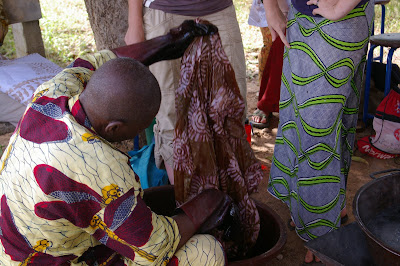
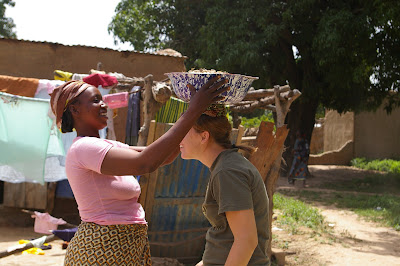
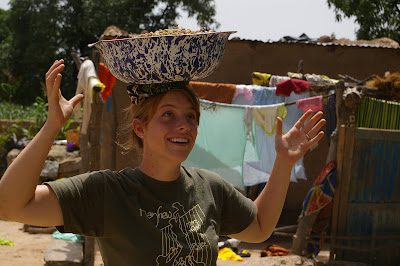
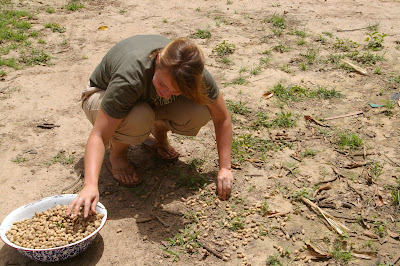
I spent the past week in a rural village called Sanankaroba about 40 minutes outside of Bamako. Here are some highlights:
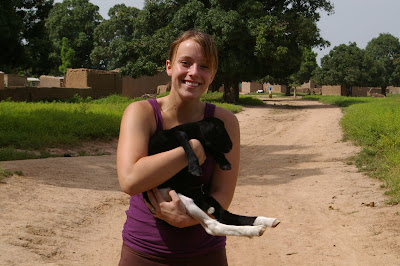
Chasing baby goats
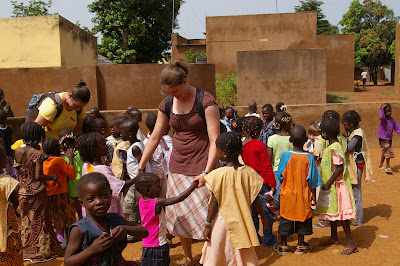
Playing baseball with the village kids

Sleeping inside a mud hut (or outside when it was too hot)
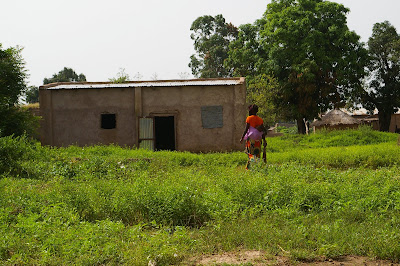
Visiting children at the Village d’Enfants S.O.S., an international organization for orphans
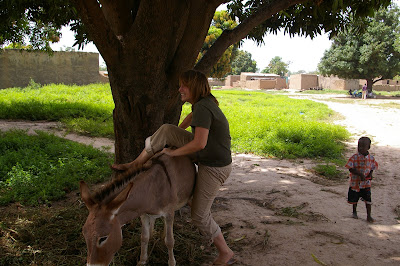
Riding a donkey
Dyeing fabric
Attempting to carry peanuts like the Malian women
...still trying...
 ...and failing.
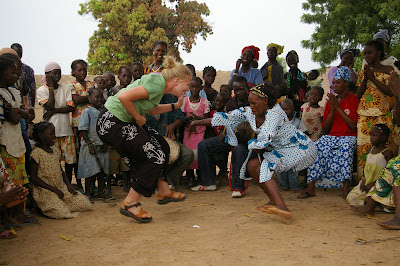
Dancing with the village women
Chasing baby goats

Playing baseball with the village kids

Sleeping inside a mud hut (or outside when it was too hot)

Visiting children at the Village d’Enfants S.O.S., an international organization for orphans

Riding a donkey

Dyeing fabric

Attempting to carry peanuts like the Malian women

...still trying...
 ...and failing.
Dancing with the village women

Wednesday, October 1, 2008
The End of Ramadan
Everyone was awaiting the end of Ramadan with much anticipation. Based on the lunar calendar, the celebrations would either begin on Tuesday or Wednesday, so most people had been preparing for two or three weeks before. My host family had been busy getting outfits made and buying shoes and food. On Saturday, I went with my sister to the Grand Marchet in Bamako, which was basically like going to the mall three days before Christmas, but worse. It was probably 95 degrees, and the market was absolutely packed. Getting anywhere was sort of like trying to shove your way to the front of a crowd at a concert. It was crazy.
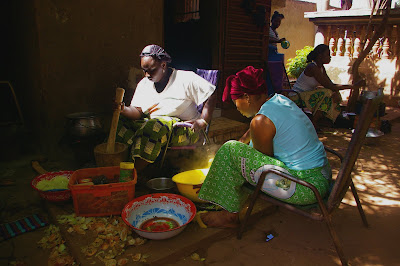
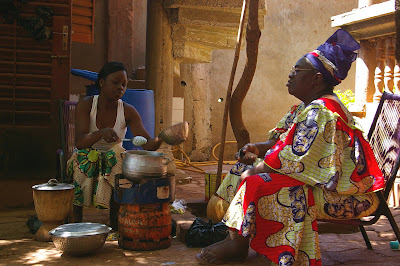
Finally, early on Monday night, someone saw the moon, and shortly thereafter, gunshots rang out in the capital, signaling that the celebrations would start the next day. On Tuesday, my family got up early to start making food. As we sat in the courtyard, groups of children and men came up to our door and recited phrases in Bambara asking for forgiveness for the things they had done. We all responded, “Amiina,” (“Amen”) and then gave the children small amounts of money. The first picture below is of my host sister Jolie on the left and my cousin on the right. The second is my other host sister Aïda and my host mom. They're in the courtyard in front of our house preparing food.
The visitors throughout the day were very interesting, but the Ramadan outfits were definitely the highlight. My entire host family had outfits made for them of bazin, an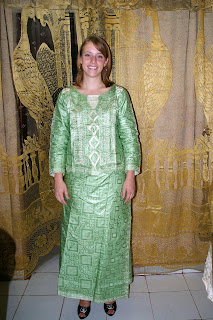 expensive fabric reserved for special occasions, and my host sister Jolie had one made for me to match hers. Bazin is made of cotton, but it has a thick waxy coat that sort of makes it like wearing an outfit made out of that red and white picnic tablecloth fabric. Basically, it was freaking hot. In the afternoon, I put the bazin on along with the heels my sister bought for me at the market, and then we left to go visit her friends as well as some of my classmates’ families. I looked pretty silly, but all the Malians were very impressed with my legit African garb.
Now that Ramadan is over, it will be interesting to see how Mali changes. Because people could only eat after sunset and before sunrise, they were generally exhausted by about 4:30pm, and many places weren’t even open after the late afternoon because people went home to sleep. Music and dancing have generally been absent, too, because those things are also banned during the daytime. Hopefully, life will get a little more interesting as things return to normal. After being here for a month, it will be nice to finally see the real Mali.
Finally, early on Monday night, someone saw the moon, and shortly thereafter, gunshots rang out in the capital, signaling that the celebrations would start the next day. On Tuesday, my family got up early to start making food. As we sat in the courtyard, groups of children and men came up to our door and recited phrases in Bambara asking for forgiveness for the things they had done. We all responded, “Amiina,” (“Amen”) and then gave the children small amounts of money. The first picture below is of my host sister Jolie on the left and my cousin on the right. The second is my other host sister Aïda and my host mom. They're in the courtyard in front of our house preparing food.


The visitors throughout the day were very interesting, but the Ramadan outfits were definitely the highlight. My entire host family had outfits made for them of bazin, an
 expensive fabric reserved for special occasions, and my host sister Jolie had one made for me to match hers. Bazin is made of cotton, but it has a thick waxy coat that sort of makes it like wearing an outfit made out of that red and white picnic tablecloth fabric. Basically, it was freaking hot. In the afternoon, I put the bazin on along with the heels my sister bought for me at the market, and then we left to go visit her friends as well as some of my classmates’ families. I looked pretty silly, but all the Malians were very impressed with my legit African garb.
Now that Ramadan is over, it will be interesting to see how Mali changes. Because people could only eat after sunset and before sunrise, they were generally exhausted by about 4:30pm, and many places weren’t even open after the late afternoon because people went home to sleep. Music and dancing have generally been absent, too, because those things are also banned during the daytime. Hopefully, life will get a little more interesting as things return to normal. After being here for a month, it will be nice to finally see the real Mali.
Friday, September 26, 2008
A Busy Week
I started off the week by getting some Henna done by a woman who came to our school. It was pretty cool, and weirdly enough, she just used black hair dye to draw on our skin. I was sort of hoping for something slightly more mystical (and something that wouldn't leave the hair on my arms permanently black), but it still looks pretty sweet. It should last for about two weeks.

With my newly henna-ed hands, I went to the zoo the next day. It wasn't really what you would expect when you think of a fun day at the zoo in the U.S., mostly because the words "developing country" and "zoo" probably just shouldn't be put together. When
 I walked in, the first thing I saw was a sign that said giving cigarettes to the animals was not allowed. Apparently visitors used to give the monkeys cigarettes all the time, but they started to get sick so they had to put an end to it. We were also pretty surprised to find out that the animals' living conditions are pretty poor. Most of them live in small concrete enclosures. A couple of the animals looked pretty sick, as well. There was a hyena that had both of its front legs broken, and it was just hobbling around. Needless to say, the zoo was a little depressing, but it definitely gave us some new perspective on things.
My next stop on the tour of depressing city institutions was on Wednesday. We no longer have classes on Wednesdays, so we're supposed to use the days to prepare for our Independent Study Projects. I think I want to do something involving children, so I spent the day with two other girls from my program at the Pouponniè re. The Pouponnière is a government-run home for abandoned children. At any given time, there are between 75 and 125 children under the age of three, as well as about 20 mentally or physically and handicapped children that are slightly older. The director took the three of us on a tour of the building and after, we stayed for three hours and helped take care of babies. The building itself is fairly nice and the caretakers do the best they can, but they are severly understaffed. Children will go for hours without any attention either laying in their cribs or on the floor, and they are frequently left in puddles of urine for hours at a time. The three of us did the best we could to help, and we all left exhausted and covered in really smelly stuff. Hopefully, we'll get to go back and help again next week.
So, this week was pretty interesting. It was a little depressing at times, but it was good to see the city and learn more about Mali. Hopefully my next post will be a little more of an upper!
Friday, September 19, 2008
Sikasso

This past weekend, our group traveled to Sikasso in the southern part of Mali. It had recently rained, and the climate is slightly wetter to begin with, so Sikasso was very green and beautiful. The roads, however, were slightly muddy.
On Saturday, we visited a cave where people of the Muslim, Christian, and animist faiths all have a designated area where they can go to pray. The cave itself is actually beneath a plateau, which we later climbed. During one part of the climb in particular, we had to pull ourselves up a rock face while holding on to a chain. It was really fun, and the view from the top of the plateau was absolutely incredible.

After that, we drove back into town and visited some historical sites including an old wall and a what is left of the Mamelon, a French fort. We also visited a large compound that belonged to the family that once ruled Sikasso. While we listened to a guide, kids from all over the place started appearing to check out the Tubabus (us). There were probably 20 or 30 kids just following us around for an hour. When we left, they chased our bus down the road. It really is hilarious who entertained they are by white people.


We got to go into town a little while later and walk around the large market where I found a really cool straw hat that I bought from an old man. I also bought a carved out kalabash with drawings burnt into it that I bought from a little girl. Many people use kalabash to prepare meals, and a common Malian blessing literally translates to "You and a kalabash full of water," after the ancient belief that God gives those who die a kalabash of water in heaven.
We wrapped up our journey to Sikasso with a visit to a waterfall (that unfortunately was a little too dirty to jump in) and a government-run tea leaf field. Sadly, we had to tell our new hotel friends goodbye and head out on Sunday. It was back to Bamako for another long week of classes.
Challenges
Life in Mali is interesting, different, and above all, challenging. These are some of toughest things for me:
Mosquitos and flies everywhere. The mosquito net is clutch, as are the bugspray and the itch relief creme that I take with me everywhere.
Bambara. It's pretty cool learning a new language, but it's less cool not really being able to understand what anyone is saying until they decide to speak to you in French.
Cockroaches. Enough said.
Air quality. The pollution in Bamako is incredible. There is a constant haze over the city, and sometimes it's just plain hard to breathe.
Trash. I can't seem to figure out where to put it. Any trash my family has, they just chuck over the wall of our compound, and I don't really want to do that. For now, I just hoard it in my armoire.
No toilet paper. This is by far the toughest thing to deal with. Somehow, wiping down with water and a hand just doesn't cut it.
So, life here is a little bit of an adjustment. I'm sure it will get easier, though, and the value of the experience will definitely be worth it in the end.
Mosquitos and flies everywhere. The mosquito net is clutch, as are the bugspray and the itch relief creme that I take with me everywhere.
Bambara. It's pretty cool learning a new language, but it's less cool not really being able to understand what anyone is saying until they decide to speak to you in French.
Cockroaches. Enough said.
Air quality. The pollution in Bamako is incredible. There is a constant haze over the city, and sometimes it's just plain hard to breathe.
Trash. I can't seem to figure out where to put it. Any trash my family has, they just chuck over the wall of our compound, and I don't really want to do that. For now, I just hoard it in my armoire.
No toilet paper. This is by far the toughest thing to deal with. Somehow, wiping down with water and a hand just doesn't cut it.
So, life here is a little bit of an adjustment. I'm sure it will get easier, though, and the value of the experience will definitely be worth it in the end.
Subscribe to:
Comments (Atom)